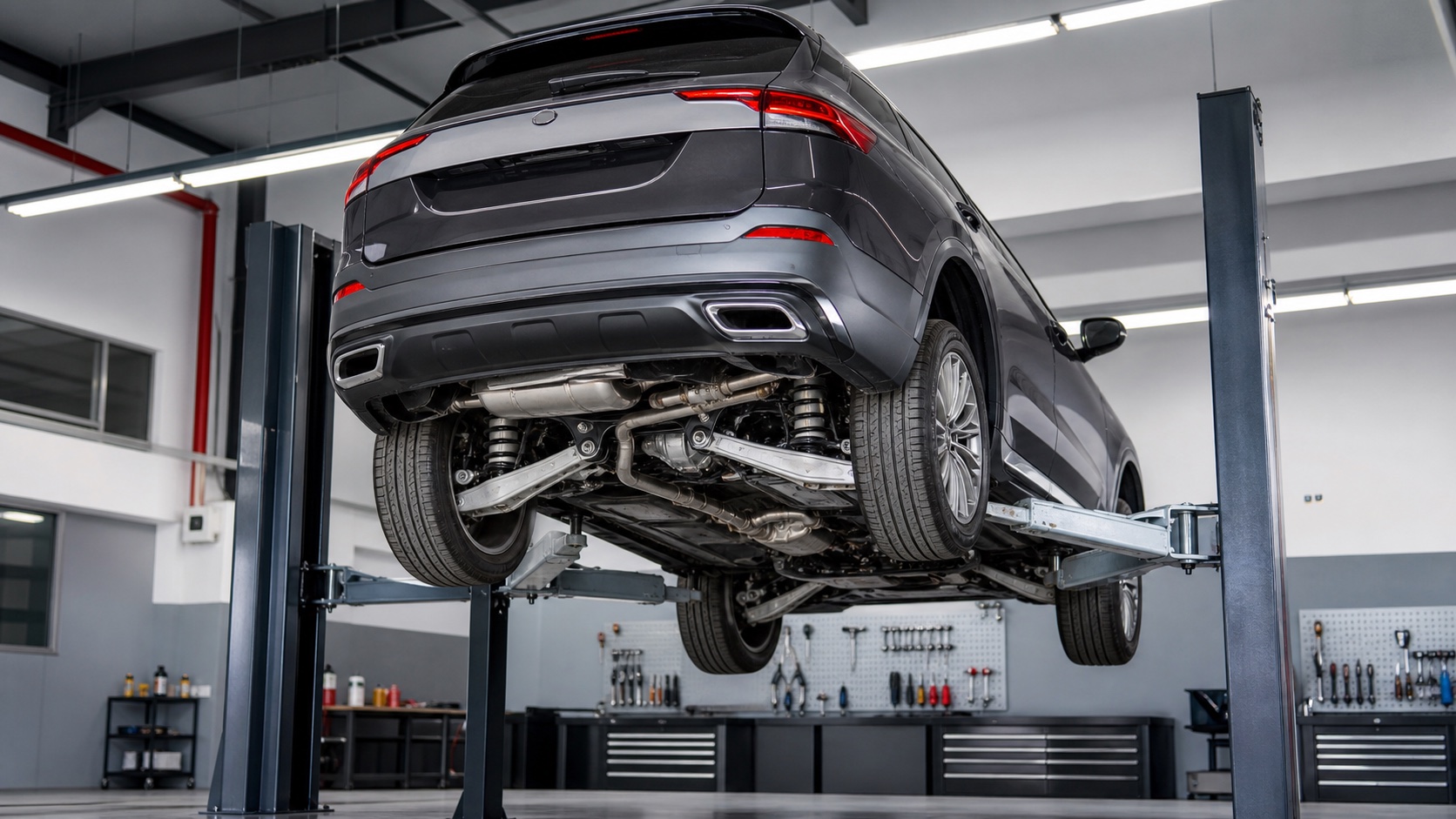
Drivetrain and suspension should be checked as a complete chassis system, not as a list of premium-sounding labels. FWD, RWD and AWD affect packaging and traction, while suspension geometry, tuning, tyres, weight and condition determine how the vehicle actually behaves.
For imported vehicles, the paper specification must also match the physical vehicle. Similar model names can hide different drive systems, rear suspension designs, wheel sizes and adaptive chassis options.
How do FWD, RWD and AWD affect vehicle use?
FWD usually favors efficient packaging and predictable everyday use, RWD separates steering from driven-wheel duties, and AWD can distribute drive to both axles for additional traction. None of the three layouts guarantees safety or handling on its own.
| Layout | How it works | Typical strengths | Common trade-offs | Familiar examples |
|---|---|---|---|---|
| FWD | The front wheels steer and deliver drive. | Compact packaging, lower drivetrain mass and useful cabin space | Front tyres handle steering, drive and much of the braking load; high-power applications require careful traction control | Toyota Corolla, Nissan Sylphy, Volkswagen Lavida, BYD Qin PLUS |
| RWD | The rear wheels deliver drive while the front wheels steer. | Balanced division of steering and propulsion, good acceleration traction and towing potential in suitable designs | A driveshaft or rear motor affects packaging; low-grip behaviour depends on tyres and stability systems | BMW 3 Series, Mercedes-Benz C-Class, Porsche 911; some EVs use a rear-mounted motor |
| AWD / 4WD | Drive can reach both axles continuously or when required. | Additional traction for low-grip roads, performance launches or off-road use, depending on system design | More components, weight and maintenance points; systems vary widely in capability | Audi quattro, Mercedes-Benz 4MATIC, BMW xDrive, Toyota and Jeep 4WD systems |
Tyres remain the vehicle’s contact with the road. An AWD vehicle on unsuitable or worn tyres can perform worse than a two-wheel-drive vehicle with correct tyres. Ground clearance, axle articulation, underbody protection, differential control and cooling also matter for off-road work.
What is the difference between part-time, full-time and on-demand AWD?
Part-time 4WD requires deliberate engagement for low-grip surfaces, full-time AWD can drive both axles continuously, and on-demand AWD adds the second axle when the control system detects a need. Buyers should identify the exact hardware rather than rely on a generic 4WD badge.
| System | Operation | Best fit | Main limitations | Brand or model examples |
|---|---|---|---|---|
| Part-time 4WD | The driver selects two-wheel drive or four-wheel drive; a low-range transfer case may be included. | Hard-core off-road use, steep tracks and low-grip work sites | Some systems must not use locked 4WD on dry high-grip roads; correct driver operation is required | Jeep Wrangler, Tank 300, selected Toyota Land Cruiser versions |
| Full-time AWD | Both axles can receive drive continuously through a centre differential or electronically controlled system. | Premium road cars, high-performance vehicles and mixed-weather use | More complex hardware and additional service requirements | Audi quattro, Mercedes-Benz 4MATIC, BMW xDrive |
| On-demand AWD | The vehicle normally prioritizes one axle and adds the other when slip or demand is detected. | Urban SUVs, touring and occasional low-grip roads | Capability and response vary; it is not automatically a substitute for low-range off-road hardware | Honda CR-V, Toyota RAV4, Haval H6, BYD Song PLUS AWD versions where offered |
Electric AWD systems may use one motor on each axle without a mechanical connection between them. The result can be fast torque response, but off-road durability, sustained output and control logic still depend on the specific vehicle.
What is the difference between independent and non-independent suspension?
Independent suspension allows each wheel on an axle to move with less direct influence on the opposite wheel, while non-independent designs connect the two sides more directly. This distinction affects packaging and wheel control, but it does not provide a complete comfort ranking.
A torsion-beam rear axle is a semi-independent design used in many compact vehicles because it is compact, durable and cost-effective. A well-tuned torsion beam can work well on paved roads. Independent layouts offer more geometry control, but poor tuning, worn bushings or unsuitable tyres can remove that advantage.
For commercial or off-road vehicles, a solid axle may be chosen for load capacity, articulation and durability. The intended duty cycle matters more than a simple independent-versus-non-independent preference.
How do common suspension layouts compare?
MacPherson strut, double wishbone, multi-link, torsion beam and air suspension solve different packaging and tuning problems. Buyers should compare the complete axle design and option package.
| Layout | Basic design | Typical advantages | Points to check | Familiar examples |
|---|---|---|---|---|
| Torsion beam | Rear wheels are connected by a beam that twists as the wheels move. | Compact packaging, low part count and useful cargo-space efficiency | Rear-wheel control on broken roads, bush condition, alignment and load suitability | Common on compact cars; exact use varies by model and generation |
| MacPherson strut | A strut and lower control arm locate the wheel. | Compact width, low mass and broad service familiarity | Strut mount, damper leakage, lower-arm bushings and alignment | Widely used for the front axle of Toyota Corolla, Volkswagen Lavida, BMW 3 Series and Honda CR-V generations |
| Double wishbone | Upper and lower arms control wheel movement. | Strong geometry control and useful wheel travel in suitable designs | Ball joints, bushings, arm damage, alignment and packaging | Performance and off-road applications, including selected Porsche, Ferrari, Tank and large SUV designs |
| Multi-link | Several links locate the wheel in different directions. | Flexible tuning for ride, handling and isolation | More joints and bushings, alignment complexity and repair cost | Common on many midsize, premium and electric vehicles, including model-dependent BMW, Mercedes-Benz, BYD and Volkswagen products |
| Air suspension | Air springs replace or supplement steel springs and can adjust height in some systems. | Ride-height control, load levelling and a broad comfort/handling range | Air leaks, compressor operation, valve block, sensors, dampers and replacement cost | Li Auto L9, NIO ES8, Mercedes-Benz S-Class, BMW 7 Series, Audi A8 where equipped |
Adaptive dampers change damping force electronically but may not change ride height. Systems marketed as CDC, MRC or adaptive damping use different hardware and control methods. Confirm the manufacturer description for the exact vehicle instead of treating all electronically controlled dampers as electromagnetic suspension.
Does an independent or air suspension guarantee comfort?
No suspension label guarantees comfort because ride quality comes from the full vehicle setup. Spring rate, damper calibration, bushing stiffness, wheelbase, seat design, body rigidity, tyre sidewall, unsprung mass and vehicle load all influence the result.
Large wheels with low-profile tyres can make a sophisticated suspension feel sharp over broken surfaces. A heavy battery pack can improve the centre of gravity while increasing the energy that the suspension must control. Software modes may also change damping, steering and powertrain response.
For batch procurement, compare vehicles with the same tyre pressure, wheel size, load and drive mode on the same route. A short showroom drive cannot reveal high-speed stability, repeated-impact control, payload behaviour or heat-related changes.
What should a drivetrain and suspension inspection include?
A chassis inspection should confirm identity, condition and operation. The following checks apply to new and used vehicles, although tolerance and evidence requirements differ.
- Match VIN, model code and option list to the quoted drive system and suspension package.
- Inspect tyres for correct size, production date, damage, uneven wear and mixed brands or patterns.
- Check wheels, hubs, wheel bearings, control arms, ball joints, bushings, springs, dampers and mounting points.
- Look for leaks or impact damage around the engine, transmission, transfer case, differentials, drive shafts and CV joints.
- Test steering centring, vibration, braking stability, low-speed full-lock operation and noises over controlled road inputs.
- For 4WD, verify engagement, warning lights, drive modes, locking functions and any low-range system according to the owner’s manual.
- For air or adaptive suspension, test height changes, compressor cycle, overnight settling, fault codes and all available modes.
- Run a diagnostic scan and record relevant chassis, stability-control, AWD and suspension faults.
An inspection result describes the vehicle checked; it does not automatically represent every vehicle in a batch. Sampling plans and acceptance criteria should be agreed before inspection.
What should be confirmed before purchase approval?
The quotation and purchase order should name the chassis configuration clearly enough to prevent substitution. Record the drive layout, 4WD system, front and rear suspension, wheel and tyre size, brakes, steering, ride-height equipment and paid chassis options.
- Define the destination road, weather, payload and service conditions.
- Confirm the exact model year and trim from manufacturer documents or build data.
- Check whether the 4WD label means part-time, full-time, on-demand or dual-motor electric AWD.
- Confirm that replacement tyres, dampers, bushings, air springs and driveline fluids are available in the destination market.
- Complete the physical and diagnostic inspection before final acceptance.
- Keep photographs, fault-code reports and configuration evidence with the purchasing record.
The vehicle inspection service covers agreed physical and diagnostic checks, while vehicle buying and export support connects the confirmed vehicle requirements to purchasing and shipping preparation. SauriVehicle can coordinate these China-side checks without presenting the result as a universal guarantee.