
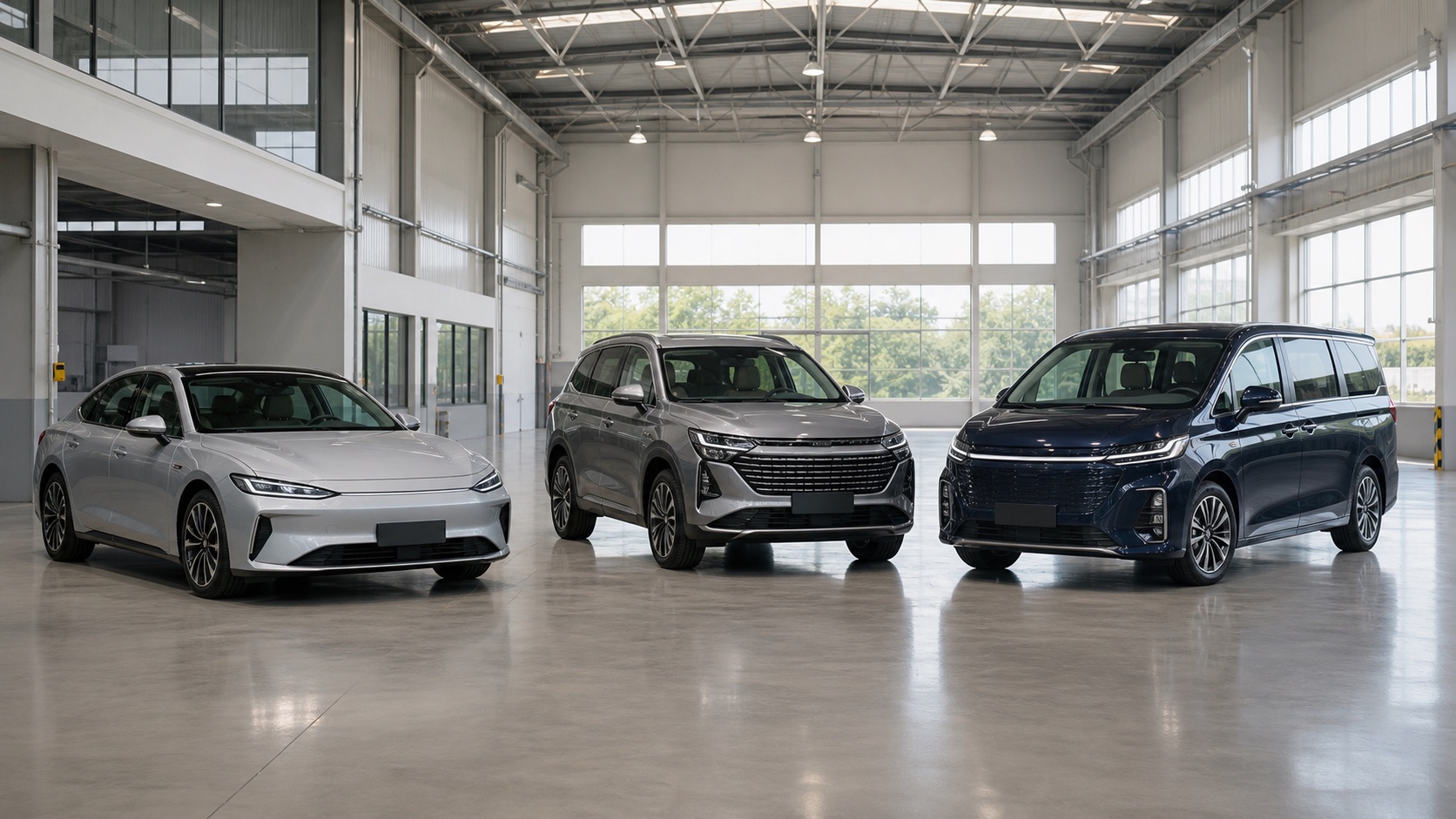
Vehicle specifications should be compared against the buyer’s intended use, destination-market requirements and exact factory configuration. Brand position and model class are useful starting points, but the final purchase decision should rely on dimensions, powertrain, safety equipment, trim code and vehicle-specific documents.
This guide explains the common labels used in the Chinese vehicle market and shows how to turn those labels into a practical comparison for sourcing and import approval.
How should buyers interpret vehicle brand tiers in China?
Vehicle brand tiers are market-positioning shorthand, not proof of build quality or supplier reliability. A brand may offer entry models, premium sub-brands and high-performance products at the same time, so buyers should use the following groups only to understand general positioning.
| Illustrative tier | Typical position | Representative brands |
|---|---|---|
| Ultra-luxury | Bespoke production, rarity, craftsmanship and very high acquisition and maintenance costs | Rolls-Royce, Bentley, Ferrari, Lamborghini, McLaren, Aston Martin |
| Established luxury | Broad premium line-ups with strong brand recognition and mature dealer networks | Mercedes-Benz, BMW, Audi |
| Premium or second-tier luxury | Distinctive technology, design, comfort or performance positioning | Cadillac, Volvo, Land Rover, Lincoln, Lexus, Jaguar |
| Global mainstream | High-volume products focused on daily usability, serviceability and value | Toyota, Honda, Nissan, Volkswagen, Buick, Ford, Hyundai, Mazda |
| Established Chinese brands | Broad model ranges, strong domestic scale and fast development in electrified vehicles | BYD, Geely, Changan, Chery, Hongqi, Wuling, Haval, Jetour |
| Chinese new-energy brands | Software-led cabins, electrified platforms and newer retail or service models | Li Auto, AITO, XPeng, NIO, Leapmotor, Zeekr, Deepal, Xiaomi EV |
For procurement, the brand badge should never replace model-level checks. A high-positioned brand can still have a base trim with limited equipment, while a mainstream or Chinese brand may offer a better specification for the intended market. Confirm warranty transferability, parts support and destination-market service options separately.
Which body type fits the intended use?
Body type should match passenger count, road conditions, cargo needs and parking environment. Sedan, SUV, MPV and sports-car labels describe different packaging priorities, but they do not by themselves confirm ground clearance, seat space or off-road ability.
| Body type | Typical strengths | Common limitations | Familiar examples |
|---|---|---|---|
| Sedan | Low centre of gravity, stable road manners, lower aerodynamic drag and a separate luggage compartment | Less ground clearance and less flexible cargo space than many SUVs | Nissan Sylphy, Toyota Corolla, Volkswagen Lavida, BMW 3 Series, Mercedes-Benz E-Class |
| SUV | Higher seating position, easier access, flexible rear seats and useful clearance for uneven roads | Usually heavier and less aerodynamic than an equivalent sedan; most urban SUVs are not hard-core off-road vehicles | Haval H6, Toyota RAV4, Honda CR-V, BYD Tang, Li Auto L7 |
| MPV | Efficient passenger packaging, easier third-row access and strong second-row comfort | Large exterior dimensions can make parking and turning more difficult | Buick GL8, Toyota Sienna, GAC Trumpchi M8, Denza D9 |
| Sports car | Low seating position, strong acceleration potential and handling-focused design | Limited passenger and luggage space, low clearance and higher running costs | Porsche 911, Ferrari F8, Chevrolet Camaro, Ford Mustang |
An importer comparing seven-seat vehicles should check usable third-row space, seat-folding method, luggage capacity with all seats raised and access to the rear row. An SUV with seven registered seats may carry less luggage than an MPV, while a large MPV may be unsuitable for narrow urban streets.
What do A00, A, B, C and D vehicle classes mean?
A00-to-D classes are informal market segments that use wheelbase, exterior size, price and positioning together. They are not a universal legal standard, and the boundaries overlap, so the exact dimensions on the model’s official specification sheet take priority.
| Indicative class | Common wheelbase reference | Typical position | Examples |
|---|---|---|---|
| A00 / city car | About 2.0–2.5 m | Compact urban transport and easy parking | Wuling Hongguang MINI EV, BYD Seagull, Volkswagen Polo, Honda Fit |
| A / compact | About 2.5–2.7 m | High-volume family and fleet use | Toyota Corolla, Nissan Sylphy, Volkswagen Lavida, BYD Qin PLUS |
| B / midsize | About 2.7–2.9 m | Family and business use with more rear-seat space | Honda Accord, Toyota Camry, Volkswagen Magotan, BMW 3 Series, BYD Han |
| C / executive | About 2.8–3.1 m | Executive comfort and longer-wheelbase packaging | Mercedes-Benz E-Class, BMW 5 Series, Audi A6L |
| D / flagship | Often above 2.9 m | Flagship luxury, rear-seat comfort and advanced chassis equipment | Mercedes-Benz S-Class, BMW 7 Series, Audi A8L |
SUVs use related descriptions such as small, compact, midsize, large and full-size. A compact SUV such as the Haval H6 or Honda CR-V and a full-size SUV such as the Toyota Sequoia or Lincoln Navigator have very different road-space, payload and shipping requirements. Do not infer container fit or passenger capacity from the segment name alone.
Which dimensions matter beyond vehicle length?
Wheelbase, width, height, ground clearance, curb weight and rated payload often matter more than overall length. Each measurement answers a different purchasing question.
- Wheelbase: the distance between the front and rear axle centres. A longer wheelbase can support more cabin space, but seat design and battery packaging also affect usable room.
- Width and height: important for road restrictions, parking, warehouse access and shipping plans. Mirror width may differ from body width.
- Ground clearance: relevant to rough roads, ramps and underbody protection. Check whether the published value is laden or unladen.
- Curb weight and gross vehicle weight: needed to understand payload, licensing, tyre requirements and transport planning.
- Seat and cargo configuration: verify the registered seat count, folding pattern and luggage space in the required configuration.
Measurements should come from an official specification sheet, conformity document or vehicle record for the exact version. A sales listing may mix figures from another trim, drivetrain or model year.
Which powertrain and chassis terms belong on the shortlist?
The shortlist should identify the energy type, drive layout, transmission or hybrid system, battery chemistry where applicable, and suspension configuration. These items affect road use, maintenance and parts planning, but no single layout is automatically the best.
For combustion vehicles, record engine displacement, induction type, maximum power, maximum torque and transmission. For electrified vehicles, record whether the vehicle is an HEV, PHEV, range-extended EV or BEV, plus battery capacity, charging ports, motor output and official test-cycle range. The separate vehicle powertrain comparison guide explains these systems in detail.
For chassis comparison, confirm front-wheel drive, rear-wheel drive or all-wheel drive, then record the front and rear suspension types. The drivetrain and suspension inspection guide covers the checks that should follow a paper specification review.
How should buyers compare safety and comfort equipment?
Safety and comfort equipment must be checked by exact trim, not by model name. A shared model badge can cover different airbag counts, camera systems, driver-assistance packages, seat functions, infotainment languages and connectivity services.
Record passive-safety equipment such as airbags, seat-belt systems and child-seat anchors separately from active systems such as electronic stability control, automatic emergency braking, blind-spot warning and lane support. Then record convenience items such as seat heating or ventilation, multi-zone climate control, keyless entry, auto hold, head-up display, parking cameras and power tailgate.
Driver-assistance names are not standardized across brands. A feature described as lane assistance may be a warning only, steering intervention, or continuous lane centring. The vehicle manual and option-code list should define the actual function and its operating limits.
What should be verified before approving a China-market vehicle?
A purchase approval should identify the vehicle precisely enough that the supplier cannot substitute a different configuration. Use the following checklist before payment or batch confirmation:
- Confirm brand, model, model year, trim name, internal variant code and VIN when available.
- Match the VIN or vehicle record to the manufacturer, powertrain and production information. A VIN decode does not prove condition, mileage or accident history.
- Collect the official specification sheet and compare dimensions, weight, seat count and powertrain with the quotation.
- Confirm exterior colour, interior colour, wheel size, tyre specification and all paid options.
- Verify safety, driver-assistance and comfort equipment on the physical vehicle or through traceable build information.
- Check software language, navigation coverage, mobile-app availability, connectivity subscriptions and over-the-air update restrictions in the destination market.
- Confirm charging connector, voltage compatibility, spare parts, warranty conditions and required export documents.
SauriVehicle supports vehicle sourcing in China through supplier assessment, specification confirmation, inspection coordination, purchasing and export preparation. The practical workflow is described in the vehicle buying process and the vehicle inspection service.