
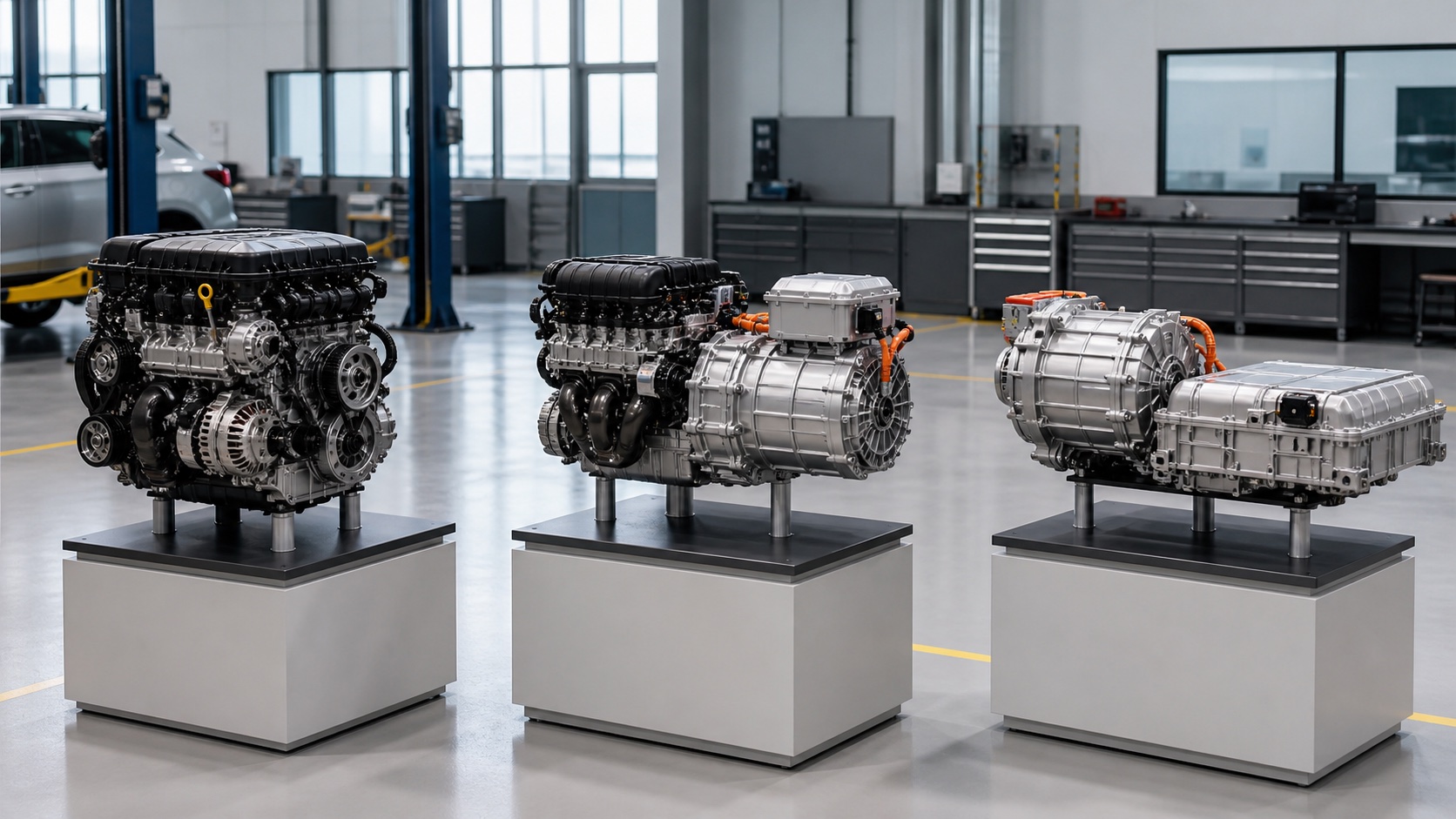
A vehicle powertrain should be chosen from the operating environment backward. Daily distance, charging access, fuel quality, service capacity, climate, payload and destination-market rules determine whether an ICE vehicle, HEV, PHEV, range-extended EV or BEV is suitable.
The powertrain label is only the first step. Importers should also confirm the exact engine or motor, transmission, battery chemistry, charging specification and model-year configuration before approving a vehicle.
How do ICE, HEV, PHEV, EREV, BEV and FCEV systems differ?
The main difference is how energy reaches the wheels and whether the vehicle can accept energy from an external charger. The table below keeps the six categories separate because their operating and infrastructure requirements are not interchangeable.
| Powertrain | How it works | Best fit | Main checks | Familiar examples |
|---|---|---|---|---|
| ICE | A gasoline or diesel engine drives the vehicle through a transmission. | Long routes or regions with established fuel and mechanical-service networks | Fuel grade, emissions compliance, engine code, transmission and parts support | Toyota Camry, Volkswagen Magotan, Honda CR-V, BMW 3 Series |
| HEV | An engine and electric motor work together; the traction battery is charged by the engine and regenerative braking, not an external plug. | Urban and mixed use where charging is unavailable | Hybrid system design, battery condition, diagnostic support and destination rules | Toyota Corolla Hybrid, Honda Accord Hybrid, Toyota Highlander Hybrid |
| PHEV | A larger battery can be charged externally, while the engine remains available for longer journeys or higher loads. | Regular charging with occasional long-distance travel | Electric range test cycle, charging port, charging speed, fuel use with a low battery and software region | BYD DM-i models, Geely Galaxy Hi-P, Volkswagen Tiguan eHybrid, BMW 5 Series PHEV |
| EREV | The electric motor normally drives the wheels; the combustion engine primarily generates electricity when battery energy is low. | Electric-style urban driving with a backup energy source for longer routes | Battery size, generator operation, sustained high-speed performance, charging and service support | Li Auto L-series, AITO M5 range-extender, Deepal SL03 EREV, Leapmotor C11 EREV |
| BEV | A battery stores electricity and one or more electric motors drive the wheels; there is no combustion engine. | Routes supported by reliable charging and planned dwell time | Usable battery, charging standard, thermal management, real route range, software and battery warranty terms | Tesla Model 3/Y, BYD Seagull, NIO ET5, XPeng G6 |
| FCEV | A fuel cell converts hydrogen into electricity for an electric motor, with water as the vehicle’s direct exhaust product. | Fleet or corridor use with dependable hydrogen supply | Hydrogen availability, tank certification, service capability and destination-market approval | Toyota Mirai, Honda Clarity Fuel Cell |
A PHEV delivers its strongest electric-use benefit when it is charged regularly. A BEV’s range changes with speed, temperature, climate-control use, load, terrain and driving style. Do not convert one test-cycle range into a fixed percentage rule for every market.
What do displacement, power, torque and engine layout mean?
Displacement describes total cylinder volume, power describes the rate at which the engine can do work, and torque describes rotational force. These figures help compare engines, but vehicle weight, gearing, tyre size and control software determine how the complete vehicle accelerates and performs under load.
- Displacement: stated in litres or cubic centimetres. A 3.0-litre six-cylinder engine has about three litres of total swept cylinder volume; it does not mean that every operating cycle consumes three litres of fuel.
- Power: usually stated in kilowatts or metric horsepower. One kilowatt is approximately 1.36 metric horsepower, but maximum power alone does not predict top speed.
- Torque: stated in newton-metres. The torque curve and transmission ratios matter more than a single peak figure for low-speed response and gradeability.
- Torque band: the engine-speed range over which strong torque is available. A broad band can make everyday acceleration easier without frequent downshifts.
A naturally aspirated engine draws air without an exhaust-driven turbocharger. It often has linear response and fewer boost-system components, but a turbocharged engine can produce more torque from a smaller displacement. Reliability and fuel use depend on the specific engine design, calibration, maintenance history and operating conditions, not the letter L or T alone.
Inline engines place cylinders in one row; inline-four engines are common in passenger cars, while BMW is well known for inline-six engines. V engines use two cylinder banks and remain familiar in V6, V8 and V12 applications. Porsche and Subaru are associated with horizontally opposed engines. W layouts have appeared in products such as the Bugatti W16 and the historic Volkswagen Phaeton W12. These layouts influence packaging and balance, but layout alone does not prove performance or durability.
Which transmission type is suitable for the duty cycle?
Transmission choice should follow traffic conditions, torque demand, driver skill and local repair capability. MT, torque-converter automatic, CVT, dual-clutch and automated manual systems use different methods to change ratio and deliver different operating characteristics.
| Transmission | How it works | Common strengths | Points to check |
|---|---|---|---|
| MT | The driver operates the clutch and selects each gear. | Simple design, direct control and broad repair familiarity | Driver demand, clutch wear, hill-start use and parts availability |
| Torque-converter AT | A hydraulic torque converter and planetary gearsets transfer and vary drive. | Smooth low-speed behaviour and the ability to handle a wide range of torque | Correct fluid specification, service history, shift quality and cooling |
| CVT | Pulleys with a belt or chain provide continuously variable ratios; some hybrid e-CVT systems use a different power-split design. | Smooth ratio changes and efficient engine operation in suitable applications | Do not confuse mechanical CVT with hybrid e-CVT; check noise, fluid, temperature history and rated torque |
| DCT / DSG | Two clutches preselect alternating gears for quick shifts. | Fast shifts and high mechanical efficiency | Wet or dry clutch design, low-speed behaviour, thermal history and service procedure |
| AMT | Actuators automate the clutch and gear selection of a manual gearbox. | Low cost and mechanical simplicity | Shift interruption, clutch wear and suitability for urban stop-start use |
Familiar examples include ZF eight-speed automatics in many BMW applications, Aisin automatics across multiple brands, Nissan CVTs, Volkswagen DSG dual-clutch systems and Porsche PDK. Exact gearboxes vary by engine, trim, production plant and model year. BYD DM-i vehicles use dedicated hybrid transmissions and should not be classified as conventional DCT vehicles simply because other BYD products have used dual-clutch gearboxes.
Which EV battery specifications need to be compared?
Battery capacity, chemistry, usable energy, thermal management, charging curve and warranty terms should be compared together. A larger advertised capacity does not automatically deliver longer real-world range or faster charging.
- Battery capacity: measured in kilowatt-hours. Confirm whether the figure is gross or usable and whether it belongs to the exact trim.
- Energy density: the energy stored per unit of mass or volume. Cell-level and pack-level figures are different and should not be mixed.
- Cycle life: a laboratory measure of charge and discharge cycles under stated conditions. Vehicle ageing also depends on temperature, depth of discharge, charging power, storage state of charge and battery management.
- Charging performance: compare connector, AC charging, peak DC power, the sustained charging curve and battery preconditioning. A peak number does not show how long the vehicle holds that rate.
- Thermal management: confirm whether the system uses liquid cooling or another method and whether preheating is available for the intended climate.
Battery warranty terms vary by manufacturer, vehicle, first-owner status, market and commercial use. Do not assume a lifetime warranty or free replacement at a fixed state-of-health threshold without the written policy for the vehicle being purchased.
How do LFP and NCM or NCA batteries compare?
LFP batteries generally prioritize thermal stability, cycle durability and lower reliance on nickel and cobalt, while NCM or NCA batteries generally offer higher energy density. Pack design, battery management and thermal control still matter, so chemistry should not be treated as a complete safety or range verdict.
| Comparison | LFP | NCM / NCA |
|---|---|---|
| General strength | Thermal stability, cycle durability and material-cost potential | Higher energy density and lower pack mass for a given energy target |
| General trade-off | Lower energy density and more pronounced cold-weather performance constraints in some applications | Greater thermal-management demands and exposure to nickel or cobalt material costs |
| What buyers should verify | Exact cell and pack supplier, usable capacity, thermal system, charging curve, warranty, software calibration and documented repair procedure | |
| Brand references | BYD Blade Battery and multiple CATL LFP applications | Many long-range or performance-focused packs from CATL and other suppliers; chemistry varies by model and region |
BYD identifies the Blade Battery as an LFP design. Tesla documentation also shows that some Model 3 vehicles use LFP batteries, while other variants use different lithium-ion chemistries. The buyer must verify the battery fitted to the specific VIN rather than infer chemistry from the model badge.
How do permanent-magnet and induction motors differ?
Permanent-magnet synchronous motors are commonly chosen for high efficiency and compact packaging, while induction motors avoid permanent magnets and can suit high-speed or secondary-axle applications. Manufacturers may use either design alone or combine different motor types in a dual-motor vehicle.
Permanent-magnet motors use magnets in the rotor and are common across BYD, XPeng, NIO, Li Auto and many other electrified vehicles. Induction motors create rotor magnetism through electromagnetic induction and have been used by Tesla and other manufacturers. The exact motor configuration can change between rear-wheel-drive, all-wheel-drive and performance trims.
Motor peak power and peak torque do not fully describe sustained performance. Importers should also check cooling, inverter limits, axle ratio, vehicle weight, battery discharge capability and whether output changes at a low state of charge or high temperature.
What should be verified before approving a powertrain?
A powertrain approval should be based on the exact variant and its real operating environment. Use the following sequence:
- Define daily distance, high-speed distance, road grade, passenger or cargo load, ambient temperature and available energy infrastructure.
- Confirm the powertrain type, engine or motor code, drive layout, transmission and rated outputs from official documents.
- For PHEV, EREV and BEV models, confirm battery supplier and chemistry where disclosed, gross and usable capacity, charging connectors, AC/DC rates and thermal management.
- Compare range and fuel-consumption figures only when the test procedure is the same. Record the test cycle and date.
- Check destination-market emissions, fuel, electrical, charging, homologation and registration requirements before purchase.
- Confirm diagnostic tools, spare parts, battery or engine warranty terms and qualified service options.
- Inspect and test the actual vehicle or a documented sample of the batch before final acceptance.
Use the vehicle specification comparison guide to place powertrain choices alongside other vehicle requirements, then connect the technical decision to the vehicle buying process in China. SauriVehicle can coordinate specification checks, supplier assessment, vehicle inspection, purchasing and export preparation in China.